
Dry coolers, chillers, heat exchangers and EC-driven fans for continuous sensible cooling — selected around free-cooling hours and PUE rather than nominal capacity.
- 1,658products across this application
- 607verified manufacturers
- 6equipment groups
WhatSensible-only cooling, measured per rack
Data centre cooling is continuous removal of sensible heat from IT equipment. Unlike almost every other HVAC application there is essentially no latent load — servers do not add moisture — so the whole design is about moving heat, and it is measured in kW per rack rather than in tonnes of refrigeration. Rack densities range from around 5 kW in older halls to well over 30 kW in modern AI and HPC deployments.
WhoWho buys data centre cooling
Colocation and hyperscale operators, telecommunications carriers, enterprise IT departments running their own halls, edge-compute deployments at cell sites and industrial premises, and the mechanical and electrical contractors who deliver these projects.
WhereFrom hyperscale halls to edge cabinets
Concentrated in established hubs, but growing fastest at the edge — small halls placed close to the users they serve, often in hot climates and without dedicated on-site staff. Those edge sites push equipment selection towards sealed, low-maintenance designs that will run unattended.
WhenBuild, upgrade and free-cooling retrofit
At new build, at capacity upgrade when rack density outgrows the original design, and increasingly as a free-cooling retrofit on existing halls where the mechanical energy bill has become the operator's largest controllable cost.
WhyDowntime, PUE and the energy share
Two reasons pull in the same direction. Downtime is the obvious one: cooling is a single point of failure for the whole facility, which is why N+1 redundancy is standard rather than optional. The less obvious one is energy — mechanical cooling can account for 30–40% of total facility power, and it is the main lever on PUE. Every hour the site can reject heat without running a compressor goes straight to the bottom line.
HowDesigning around free-cooling hours
Design the water temperatures first, because they determine everything else. Raising chilled water supply to 18–20 °C — which modern IT equipment tolerates comfortably — hugely increases the number of hours per year a dry cooler can reject heat with no compressor running at all. Then select fans with EC motors and variable speed, so fan power falls with the cube of speed as the load drops, and size for N+1 so any single unit can be taken out for service without touching the IT load.
Equipment this application needs
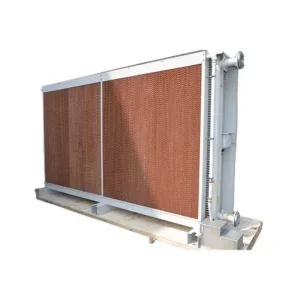 Free cooling
Dry Cooler189
Rejects heat directly to ambient air with no compressor running. The single biggest lever on annual energy use in a temperate or continental climate.
Free cooling
Dry Cooler189
Rejects heat directly to ambient air with no compressor running. The single biggest lever on annual energy use in a temperate or continental climate.
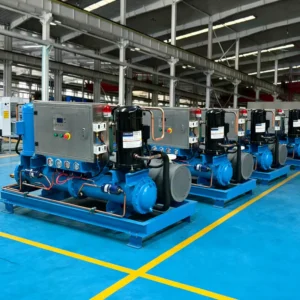 Mechanical cooling
Chilling Equipment88
Carries the load when ambient is too high for free cooling. Sized for the design day but running part-load most of the year, so part-load efficiency matters more than peak COP.
Mechanical cooling
Chilling Equipment88
Carries the load when ambient is too high for free cooling. Sized for the design day but running part-load most of the year, so part-load efficiency matters more than peak COP.
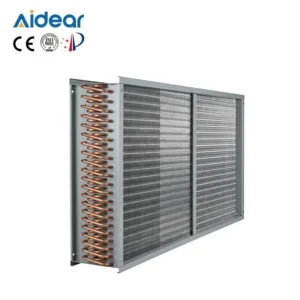 Circuit separation
Heat Exchangers160
Plate exchangers separating the glycol loop from the chilled water loop, and enabling indirect free cooling.
Circuit separation
Heat Exchangers160
Plate exchangers separating the glycol loop from the chilled water loop, and enabling indirect free cooling.
 Evaporative rejection
Cooling Towers135
Higher rejection capacity per unit footprint where water is available and treatment can be maintained.
Evaporative rejection
Cooling Towers135
Higher rejection capacity per unit footprint where water is available and treatment can be maintained.
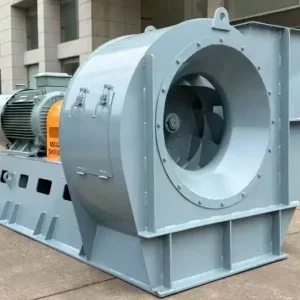 Air handling
Centrifugal Fans414
CRAH and AHU fan sections — EC plug fans with speed control to hold supply temperature as IT load varies.
Air handling
Centrifugal Fans414
CRAH and AHU fan sections — EC plug fans with speed control to hold supply temperature as IT load varies.
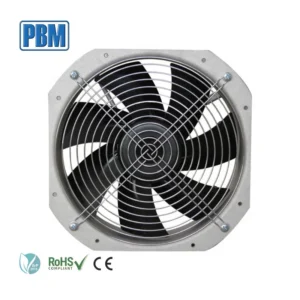 Condenser & cooler fans
Axial Flow Fans672
The fan side of dry coolers and condensers, where EC drives and low tip speed cut both energy and noise.
Condenser & cooler fans
Axial Flow Fans672
The fan side of dry coolers and condensers, where EC drives and low tip speed cut both energy and noise.
What to check before you order
- EC Motor 160
- Electronically commutated motors — the efficiency baseline for any modern fan-driven cooling equipment.
- Variable Speed 72
- Fan power falls roughly with the cube of speed, so part-load hours are where the savings actually are.
- Energy Saving 861
- PUE is a contractual commitment for most colocation operators, not a marketing claim.
- Low Noise 504
- Urban and edge sites are frequently permitted on a night-time noise limit at the boundary.
- R410A Refrigerant 291
- Still common in packaged units; check the phase-down position in your market before standardising on it.
Products for this application
-
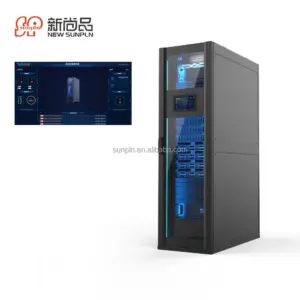 View & Inquire
Cooling Towers, HPC
$300.00 -
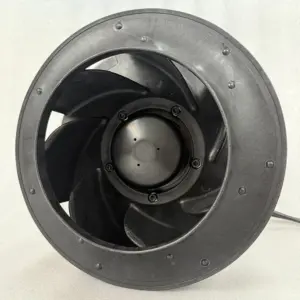
- 220 V
- Aluminum Alloy
- 58.9dB(a)~91dB(a)
-
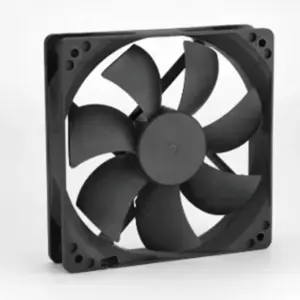
- 12 V
- Power Source Electric
- Blade material Plastic
-
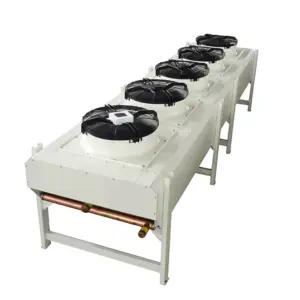
- 400 V
- 380V/3PH/50HZ
-
View & Inquire
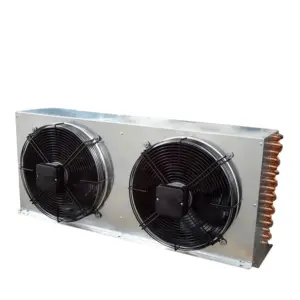
-
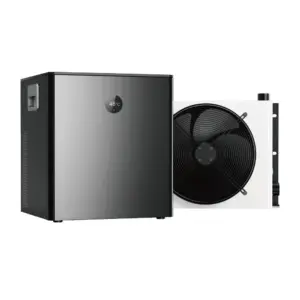
- Noise 30dBA
-
- 5000m³/h
-
- 380 V
-
View & Inquire
-
- Material Aluminum
-
View & Inquire
-
- 380V
- Noise 70dba
Questions buyers ask
When is free cooling worth specifying?
Why do data centres use EC fans rather than AC fans with a VFD?
What does N+1 mean for cooling equipment procurement?
Related applications
Tell us about your data center cooling equipment project
Send the duty and site conditions and we will come back with matched equipment, price and lead time from the manufacturers listed here — usually within one working day.