
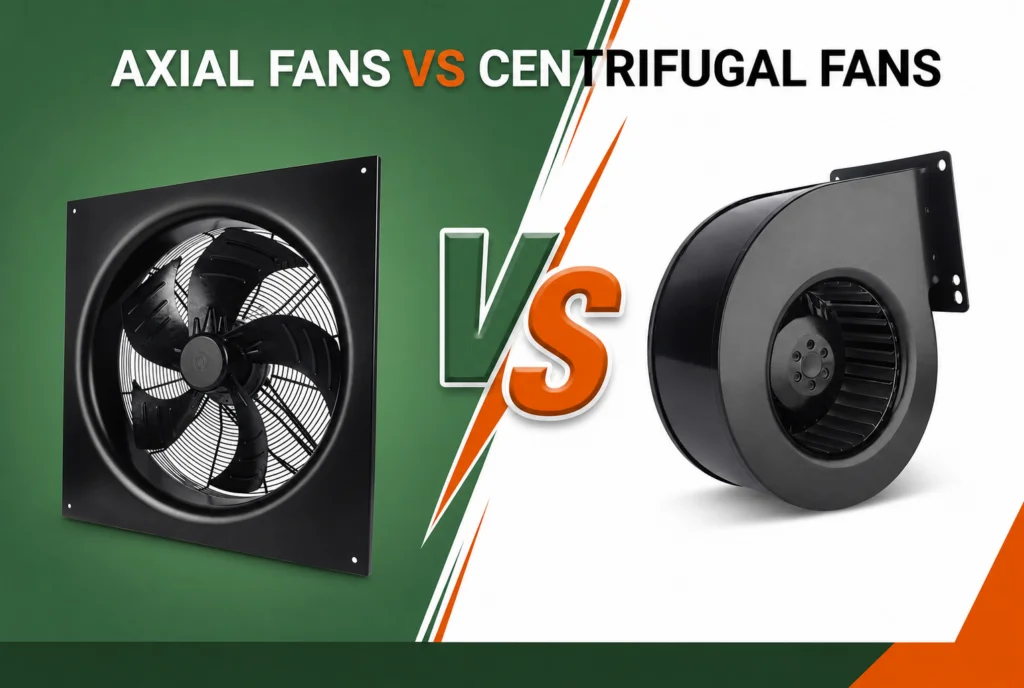
Axial fans and centrifugal fans are tow of the most widely used fan types in ventilation and HVAC systems. If you’ve spent any time specifying fans, you know that axial and centrifugal fans aren’t interchangeable in many applications. The decision between an axial fan and a centrifugal fan often depends on the balance between airflow capacity and pressure requirements. Beyond airflow and pressure, engineers should also evaluate factors such as density, temperature, humidity, noise levels, and system constraints. Here’s a practical way to think about it, stripped of the marketing fluff.
What is Axial Fan?
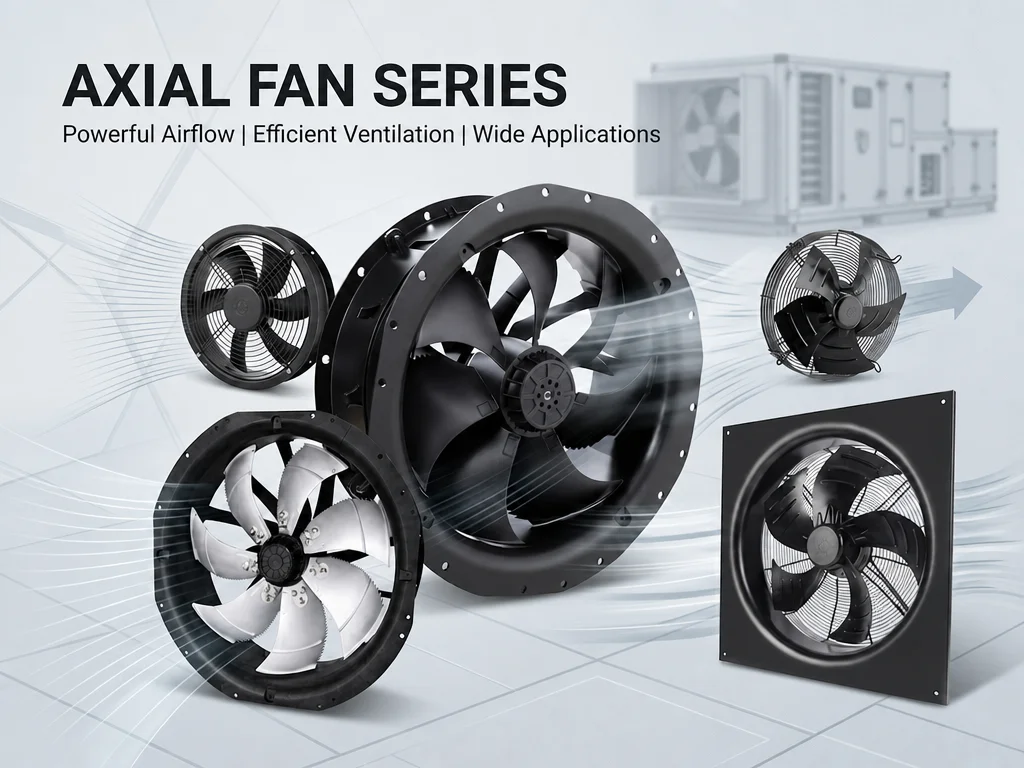
Originated from medieval windmill design, axial fan is a type of air-moving device with a motor-driven rotating shaft (axis). The rotating blades of the axial fan move air parallel to the axis of the fan shaft, making axial fans ideal for ventilation and cooling. Axial fans come in various sizes to fit different room sizes.
How Does Axial Fans Work?
An axial fan works by moving air with rotating blades mounted around the central shaft. When the motor drives the impeller, the blades generate aerodynamic force and create the pressure. The motion of the blade create the low-pressure behind the fan and higher-pressure infront of the fan. The air then flows straight through and comes out in a continuous stream. This straight-through design enables axial fans to deliver large volumes of air. One of the benefits of axial fans is that they’re particularly efficient when moving lots of air rapidly.
Features and Advantages
- High Airflow: Air moves straight through the impeller along the axis, so axial fans are excellent at moving a large volume of air, ideal for ventilation, cooling, and circulation applications.
- Space Saving: Axial fans are built in-line. The compact design makes the axial fans suitable for equipment racks, condenser coils, wall openings, or tight mechanical rooms where every centimeter is spoken for.
- Energy Efficiency: Axial fans operate closer to their peak efficiency point in the applications they’re designed for. When paired with an EC motor, axial fans can be more energy-efficient.
What is Centrifugal Fan?
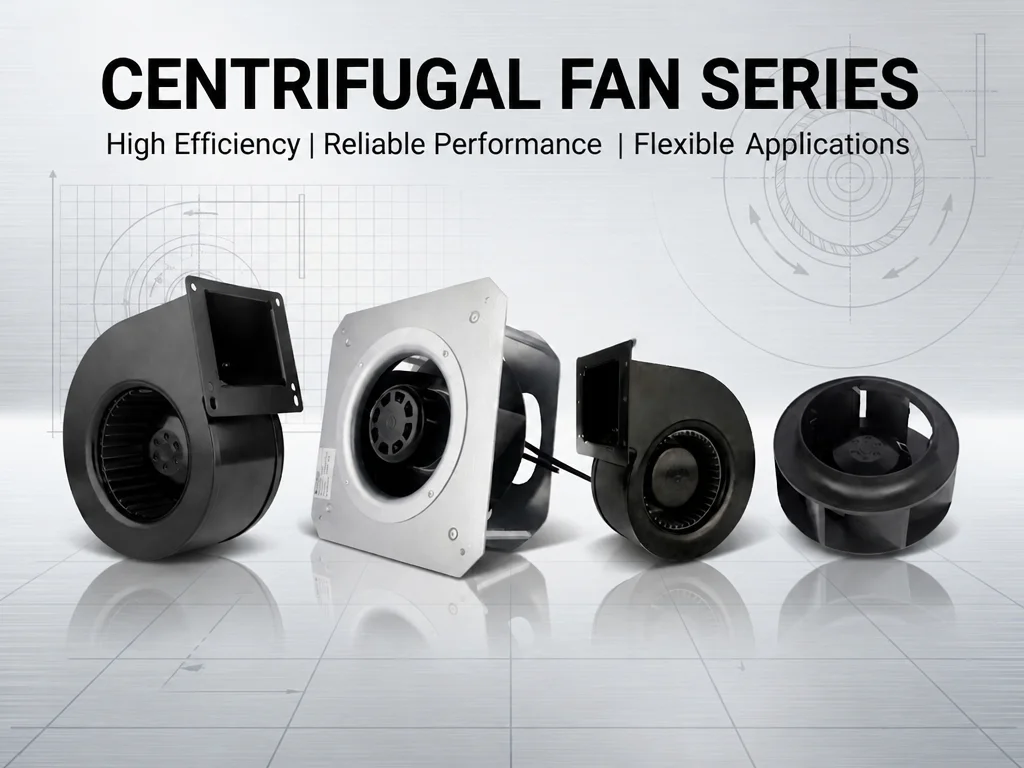
The centrifugal fan is also an air-moving device that uses the rotating impeller to draw air into the center of the fan. Unlike axial fan, which moves air in a straight line, the centrifugal fan moves the air outward from the center of the rotation and the air changes to 90-degree angle before discharging. Centrifugal fans are widely used in HVAC systems, industrial ventilation, and AHUs.
How Does Centrifugal Fans Work?
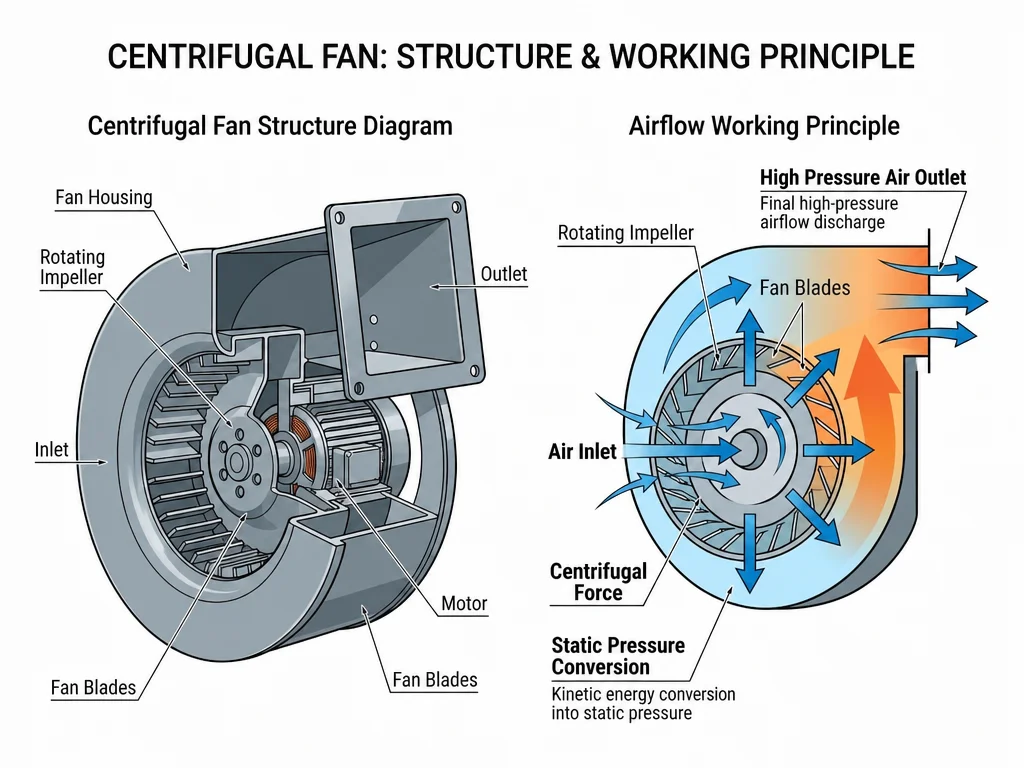
Centrifugal Fans are defined as fans that have rotating blades, which are arranged in a wheel. The blades rotate and suck air towards the middle of the fan. The air is then forced outwards into the sides of the fan. The high speed air is then collected by the fan housing and the kinetic energy is converted into static pressure before the air exits. Centrifugal fans are specifically suitable for applications that require high static pressure and more stable performance when the airflow should overcome resistance.
Features and Advantages
High Static Pressure: The combination of the scroll housing and impeller geometry converts rotational energy into pressure. In ventilation systems where resistance is unavoidable, static pressure is one of the key factors that can determine whether the fan can maintain the required airflow and centrifugal fans are the best choice.
Consistent Airflow Performance: Centrifugal fans usually have a predictable performance curve where airflow and pressure vary. This stability is critical in cleanrooms, medical ventilation, and process exhaust.
Blade Type Versatility: Centrifugal fans come in forward-curved and backward-curved fan blades. Forward-curved blades deliver high volume at low pressure for residential and light commercial HVAC. Backward-curved blades handle higher pressures efficiently with a self-limiting power curve that protects the motor.
Axial Fan vs Centrifugal Fan: Key Differences
The air flow in axial fans is parallel to the shaft, high speed and low pressure, suitable for general ventilation in open rooms. Centrifugal fans make use of the centrifugal force to move air towards the impeller and send it out radially, in cases of resistance from duct, filter or equipment, centrifugal fans produce a greater static pressure and more stable air flow. The axial fan mainly emphasizes the high flow rate of the fan and straightforward ventilation, while the centrifugal fan focuses on system resistance, stability, and airflow.
Airflow Capacity Comparison
Airflow capacity is typically measured in cubic meters per hour (m³/h) or cubic feet per minute (CFM). Axial fans are generally designed for high-volume, low-pressure applications. They work best in large environments like factory floors, warehouse, and general-purpose cooling systems. Centrifugal fans deliver a more consistent airflow at moderate to high volumes while generating significantly greater static pressure. Centrifugal fans have a steadier air volume in ducting, filtration, or process equipment where axial fans can meet sharp performance degradation.
Static Pressure Capability
One of the most crucial differences between axial fan and centrifugal fan is static pressure capability. Axial fans are engineered for low-pressure applications where the primary goal is efficient air exchange with minimal obstruction. They perform well in open ventilation and spot cooling. However, they are not suitable for long duct runs. Centrifugal fans are designed with fan impeller that can create centrifugal force to accelerate air outward and the housing converts this energy to pressure. So centrifugal fans have the capability to generate higher static pressure. They are suitable for use in HVAC ductwork, air handling units, filtration systems and industrial ventilation systems where steady airflow performance is essential.
Energy Efficiency and Power Consumption
The fan operating conditions and system resistance affect energy efficiency. In low resistance applications, axial fans can move greater quantities of air with less resistance. Centrifugal fans are most effective to help maintain consistent air flow in high resistance systems that have ducts and filters and equipment in place. EC motor and variable speed technology can also further optimize energy use by varying the airflow in response to demand with centrifugal fans.
Noise Comparison
Axial fans, tend to produce higher noise level especially when these fans operate against resistance. So they may be more ideal for open spaces and not suitable for noise-sensitive environments. Centrifugal fans usually offer quieter operation with enclosed design and controlled airflow reduce turbulence, particularly in ducted HVAC systems. Centrifugal fans can be more suitable for indoor facilities ventilation project and commercial HVAC systems.
Installation Flexibility
Installation requirements vary for different designs of ventilation system and application environments. Housed in a compact and lightweight form, axial fans require less space and can be easily mounted on flat surface. They can be simple to install in wall-mounted, roof-mounted, or simple ventilation paths. Centrifugal fans require a 90°change in airflow direction, meaning that they need more installation space and precise planning of inlet and outlet orientations. But once installed, centrifugal fans integrate seamlessly with ductworks, filters, heat exchangers, and air handling units.
Maintenance Requirements
The design of an axial fan is typically simpler, meaning that it is easier to inspect, clean, and service. The simplicity also translates to lower maintenance and faster service. The installation of axial fans is very important and the poor installation can reduce efficiency. Centrifugal fans are designed for higher performance applications, and the robust construction of the housing and impeller gives better protection and long term reliability, especially when used in ducted or industrial applications. While maintenance is more involved, the trade-off is a fan designed to operate reliably under demanding conditions for years — provided inspections are performed on a regular schedule. You should check some vital parts like bearings, impellers, and filters from time to time to keep working at the highest level of performance.
Core Performance Comparison: Axial vs. Centrifugal Compressors
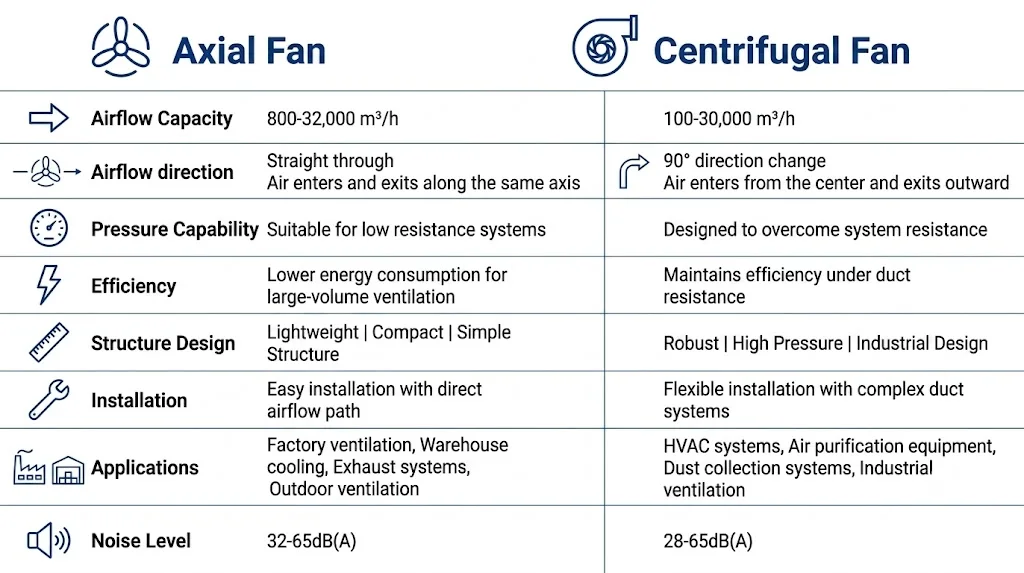
Axial fans are a solid option when you want to move a large amount of air without needing high pressure. Centrifugal fans are the better fit when high pressure matters, such as in systems that use ductwork. Axial fans are compact and usually operate quietly, which makes them ideal for areas where noise is a concern. Centrifugal fans take up more space and tend to be louder, but they perform well in tougher applications that require strong pressure.
Application Scenarios: How to Choose Between Axial Fans and Centrifugal Fans?
The first step to choosing the best fan is to understand the room requirements. One has to consider all aspects of the fan selection process. By taking these steps, you can ensure that the fan operates efficiently for cooling and ventilation.
Overall Selection Summary
| Selection Requirement | Suitable Fan Type | Typical Applications |
| High airflow volume + low pressure | Axial Fan | Warehouses,cooling towers,tunnels, greenhouses,general ventilation |
| Open-space ventilation | Axial Fan | Factories, parking garages, agricultural buildings |
| Direct equipment cooling | Axial Fan | Motors,condensers,electrical cabinets |
| Long duct systems | Centrifugal Fan | HVAC systems,industrial ventilation |
| High static pressure requirement | Centrifugal Fan | Cleanrooms, dust collectors, combustion systems |
| Airflow through filters | Centrifugal Fan | HEPA systems, pollution control, fume extraction |
| Industrial process applications | Centrifugal Fan | Chemical plants, manufacturing exhaust, boilers |
Axial Fans: Suitable for Open Space Ventilation or High Air Volume Settings
In applications where it is required to move a large amount of air at low pressure loss, axial fans are employed. They pass air right over the fan shaft, and can be used in free spaces where ventilation and air circulation are the main concerns. These are typically used for tunnel ventilation, cooling towers, parking areas, workshop etc and factory ventilation. But, when there is a need for the system to be easily installed, direct airflow, and when it is cost-effective to ventilate, axial fans are ideal.
Centrifugal Fan: Suitable for High Pressure and Multi-Purpose Fan System
Centrifugal fans are made for applications in which the stable airflow performance and higher pressure capability is required. They are able to overcome resistance in ducts, filters, and ventilation equipment by adjusting direction of airflow using centrifugal force. They can be found in HVAC systems, air handling units, dust collection systems, industrial exhaust, cleanrooms and clean room process ventilation. In situations where it is important to have reliable airflow control, pressure performance and continuous operation, centrifugal fans are the preferred choice.
FAQs
What is the main difference between axial and centrifugal fans?
The difference is that axial fans move air in one direction while centrifugal fans eject it perpendicularly to the fan shaft. Both types have particular advantages and can be used in various environments. Axial fans are suitable for open areas, whereas centrifugal fans are used for high-pressure operations.
How do I determine appropriate fans for a small room?
You need to consider room dimensions and air flow requirements. Axial fans will be more suitable for a small room as they are compact and occupy less space than centrifugal ones. Besides, axial fans are less noisy.
Are fans loud?
Noise will depend on fan type and operating conditions. The noise of an axial fan depends on low-pressure regimes while centrifugal fans can be rather noisy when they perform their tasks under extreme conditions.
Do fans require maintenance?
Fans have to be cleaned and checked to operate effectively. Fans which are axial in nature require little maintenance. Centrifugal fans require more maintenance than others. Maintenance ensures that fans operate effectively and save on energy. One has to follow the manufacturer’s guidelines for the fans.