
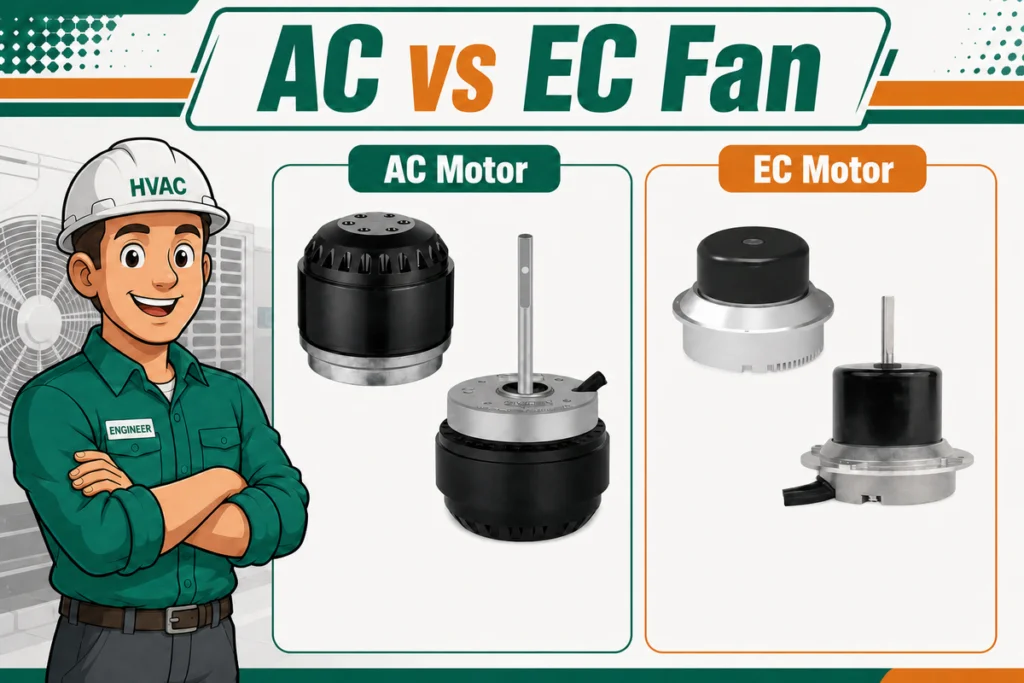
Electric motor can be found in many modern appliances and industrial system such as air conditioners, washing machines, and cleaners. In HVAC systems, electric motors power fans to circulate air and regulate temperature. Based on motor technology, HVACR fans can be divided into AC, DC, and EC fans. While AC fans have been widely used for decades for their simple structure and cost effectiveness, EC fans have been more and more popular for their energy efficiency. This article will delve into detailed differences between EC fans and AC fans in terms of working principle, efficiency, cost, control, reliability, and application scenarios.
What is AC Fan?
AC fans have been used for commercial and industrial air ventilation for decades, which are known for their simple structure and low cost. AC motor uses alternating current from the main supply to energize and change the pole of the electromagnets. It is powered by AC induction motor, which is one of the mature motor technology in the world.
So, how does AC fan work? The stator winding operated by AC supply produces a rotating magnetic field. As the stator field sweeps across the squirrel-cage rotor, electromagnetic induction generates a corresponding induced magnetic field in the rotor and the interaction between these magnetic fields drives the rotor to spin. AC fans usually operates on a fixed speed unless additional speed control devices are added.
What is EC Fan?
EC fans are powered by EC motor, which combines a brushless DC motor with integrated electronic control. Unlike traditional AC fans, EC fans use permanent magnetic and electronic controller to generate rotation. The AC power enters into the integrated electronic controller and the controller will convert the AC power to DC power. And then the regulator will send the current in the regulated direction, which creates a rotating magnetic field that drives the rotor and fan impeller. EC fans allow for precise motor control and improve energy efficiency.
EC Fan vs AC Fan: Key Differences
It is known that EC fans outperforms AC fans on energy efficiency. But the real story is that they have differences in speed and noise control, size and cost comparison. For OEMs and system integrators, understanding these differences can help you unlock measurable competitive advantage. Let’s break it down.
Motor Type
EC fan uses electronically commuted motors with permanent magnets in the rotor and integrated control electronics. The key features of EC fan include permanent magnetic rotor, built-in microprocessor, and IE4/IE5 efficiency class.
AC fan relies on traditional AC induction motors. It runs directly off the mains frequency without any electronics. AC fans are simpler than EC fans, but they usually use more energy and produce more heat.
Airflow Control
AC fans typically operate on fixed speed. And the speed control is stepped and narrow-range. The speed variation of AC fans often depend on external control devices like variable frequency drive (VFD). However, VFD may be affected by electromagnetic interference and insulation stress.
EC fans are infinitely variable across their entire speed range — typically from 0% to 100% — without torque loss at low RPM. Control interfaces are built in 0–10V analog signal, PWM input, or MODBUS RTU / RS-485 controls. So, compared to traditional AC fans, EC fans can achieve high efficiency and fast response time.
Energy Efficiency
EC motors use permanent magnets, so there is no current flow in the rotor and zero I²R loss there. AC motors must slip (run slower than synchronous speed) to produce torque. EC motors rotate in perfect lockstep with the stator field, so there is no slip loss.
EC fans are typically 10% to 20% more efficient than AC fans. EC fans provide 70% to 92% efficiency and uses 50% less electricity compared to AC fans. AC fans usually have an efficiency of 50% to 80%. System-level savings of 50–70% are well documented in retrofit projects.
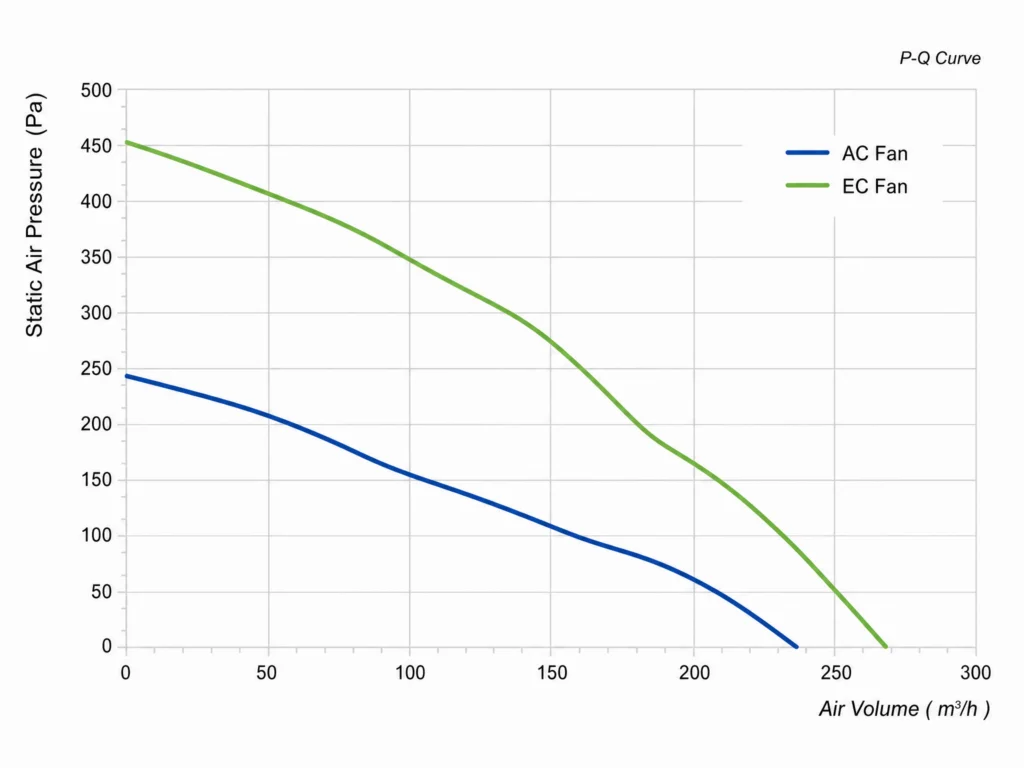
Noise Control
Noise is another big factor. AC fans run at higher RPM for the same airflow and have line-frequency hum. In dB(A) numbers, an EC fan is typically 3–8 dB quieter than an equivalent AC fan at the same operating point. The typical measured noise level of EC fans is between 28 and 35 dBA, while AC fans have more noise, ranging from 40 to 50 dBA.
Size Comparison
Size matters in equipment design especially in compact HVAC systems. AC fan systems grow in size with larger stator stack, external capacitor, external controller, and heavier construction. The EC fan assembly is typically 20–40% smaller in envelope volume and 30–50% lighter than an equivalent AC fan with external speed control. Please note that in practical applications, the dimensions of EC fans and AC fans vary based on different environments.
Cost Comparison
The cost comparison of EC fans and AC fans include two parts: upfront cost and operating cost. AC fans have mature technology, so the upfront cost can be lower than EC fan installation. Because of the complex components like permanent magnetic motors and sensors, EC fans have higher upfront cost. However, EC fans have lower operating electricity and maintenance cost. Beyond direct energy savings, EC fans reduce costs in reduced HVAC cooling load, longer service life, and circuit protection.
EC Fan vs AC Fan Performance Comparison
Here is the performance comparison chart of EC fans and AC fans for the quick reference.
| Dimension | EC Fan | AC Fan |
| Motor type | Electronically commutated (BLDC + permanent magnets) | Induction (shaded-pole or PSC) |
| Efficiency (system) | 70–92% | 50–80% |
| Speed control | 0–100% infinitely variable (0–10V, PWM, MODBUS) | Stepped or narrow-range (transformer taps, triac, external VFD) |
| Part-load efficiency | Stays high across range | Collapses below ~50% speed |
| Noise | Quieter | Louder |
| Size & weight | Compact, lightweight, integrated electronics | Larger frame; external capacitor/controller needed |
| Upfront cost | Higher (1.5–3× motor alone; 1.1–1.3× installed with controls) | Lower motor cost; higher installed cost when VFD added |
| Operating cost | Low | High |
| 10-year TCO | Winner | Higher total cost |
| Reliability | Higher reliability, fewer mechanical parts | Lower reliability |
| Maintenance Requirements | Less maintenance, longer lifespan | More frequent maintenance |
| Best for | Variable-airflow, energy-sensitive, noise-sensitive applications | Fixed-speed, budget-constrained, short-runtime applications |
How to Choose Between EC and AC Fans?
Before choosing the right fan, ask yourself the following questions:
- How many hours per year will this fan run? Under 1,000 h → AC may work. Over 2,000 h → EC almost always wins on TCO
- Do you need variable airflow — or is fixed speed enough? Variable airflow is the norm in modern HVAC. If “yes,” EC eliminates the cost and complexity of external VFDs or tap controllers.
- Is the environment noise-sensitive? Hospitals, offices, hotels, residential → EC. Industrial warehouse with 85 dBA background noise → AC may be fine.
- Do you have space or weight constraints? Compact equipment like fan coil units, heat pumps, and close-coupled AHUs → EC’s smaller footprint and lighter weight matter.
AC Fans can be the most suitable for those low-budget airflow projects and low annual runtime. In harsh electrical environments where power quality is poor, the AC fan is also a better option than EC fans with sensitive onboard electronics.
EC fans are more recommended for high-energy-consumption applications, noise sensitive environments and those airflow projects with in intelligent control and operation. EC fans are often used in data center cooling, commercial HVAC AHU, Fan coil unit (FCU), and cleanroom.
Future Trends of Electric Motor
With stricter energy regulations and more advanced technology, the development of electric motor is moving forward higher efficiency, smarter control, and better system regulation. Both Europe and the US have introduced stricter regulations for energy efficiency such as ErP 2026 and US DOE efficiency standard. Technology also develops fast in the HVAC world and EC fans have definitely become the popular fan type for many companies who are seeking for energy-efficient and green building goals. The future trends of electric motor means for OEMs and system integrators. Design for IE4/IE5 now, evaluate your motor supplier’s sustainability roadmap, and reduce your BOM by integrating.
FAQs
Can I directly replace an AC fan with an EC fan?
In most cases, yes — EC fans are designed as drop-in replacements for common AC frame sizes. They accept the same mains voltage input (115V, 230V, etc.) and can use the existing mounting. Choose the right fan manufacturer for your AC-to-EC fan retrofit.
Do EC fans require special maintenance?
Generally less. The sealed ball bearings are typically rated for 40,000–60,000 hours (L10). The main failure point in EC fans is the electronics, not the motor itself.
Are EC fans quieter than AC fans?
Yes. EC fans can be quieter than AC fans with less vibration and noise level.